
Is Mid-Term Rental the Right Strategy for Your Hamilton Property?
Summary: Mid-term rentals — furnished tenancies of one to six months — typically generates 35 to 55 % more monthly income than a long-term lease on the same Hamilton unit. They sit outside Ontario's rent control framework, draw professionally vetted tenants on employer-funded placements, and carry lower vacancy risk than standard annual leasing for well-located properties near Hamilton's major hospitals and downtown core.
Hamilton's rental market felt straightforward just a few years ago. You listed a unit, had applicants within days, and picked the best one. The math was simple and the effort felt proportional to the return.
Today it's more complicated. Vacancy periods are longer. Finding the right tenant takes more work, and the wrong one — someone who treats the unit as temporary and acts like it — is a real cost. Rent control caps your annual increase at 2.5% while your insurance, maintenance, and carrying costs keep climbing. You're doing more work for a flatter return than you were three years ago, and the long-term lease model that felt safe isn't delivering the way it used to.
Mid-term rental is emerging as the strategy Hamilton's more deliberate landlords are using to close that gap. It won't work for every property. But for the right unit in the right location, it changes the math in a meaningful way.
Here's what it actually looks like in 2026.
What Is A Mid-Term Rental in Ontario?
A mid-term rental is a furnished tenancy between one and six months. It sits between a short-term Airbnb booking and a standard annual lease. No nightly chaos. No 12-month commitment. A different tenant profile and, typically, a meaningfully higher monthly return.
Hamilton's vacancy rate hit 3.6% in 2025 — the highest since the pandemic, according to CMHC, driven by condo completions and declining student demand. That softness is concentrated in the long-term market. The mid-term market draws from a different demand pool entirely: healthcare professionals on placement, corporate relocations, insurance displacement clients, and professionals on fixed-term assignments. That demand runs on hospital staffing schedules and corporate posting cycles. It runs year-round.
How Much More Can a Hamilton Landlord Earn With A Mid-Term Rental?
We compared 1-bedroom 1-bathroom long-term rentals in Central Hamilton to 1-bedroom 1-bathroom mid-term rentals in the same neighbourhood across over seven booking platforms. Here’s what we found:
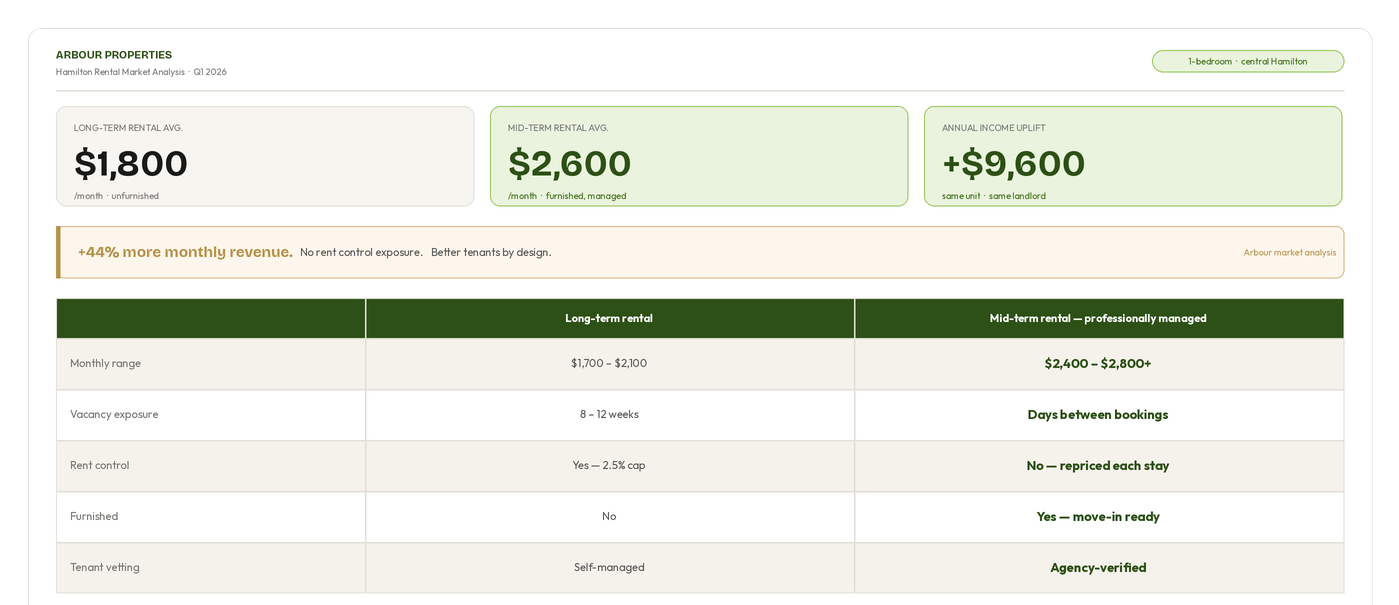
Monthly income comparison for a 1-bedroom unit in central Hamilton, Q1 2026. Source: Arbour Properties market analysis, cross-referenced with Rentals.ca, CMHC, and active listings on MedsHousing, Kijiji, Zumper, Facebook Marketplace, Airbnb Monthly Rentals, and more.
Wondering what your specific unit could generate? We'll run the numbers for you.
Who Books Mid-Term Rentals in Hamilton?
Hamilton has one of the most concentrated mid-term tenant pipelines in Ontario. Hamilton Health Sciences employs over 18,000 people across 11 sites. St. Joseph's Healthcare adds 5,000 more. McMaster Medical School runs over 800 residents rotating every four to eight weeks across 51 specialties. Most of these people are not from Hamilton. Very few of them want to sign a year-long lease.
Beyond healthcare, Hamilton draws corporate relocations, insurance displacement clients, and professionals on project-based assignments. These are not vacationers. They are people who need a home for one to three months, are often being paid a housing stipend by an employer or agency, and treat a unit accordingly.
The price point itself does a lot of the filtering work. A $2,500 per month furnished unit attracts people who need it for a reason — a rotation, a placement, a relocation package. They're not looking for a deal. They're looking for something turnkey that works while they're focused on the job that brought them to Hamilton. Layer proper screening on top — employment verification, references, direct relationships with healthcare staffing agencies and hospital HR departments — and you're not renting to whoever applies first. You're filling a unit for someone who was placed there by a professional organization and has every reason to treat it well.
Mid-Term Rental Management in Hamilton: What Landlords Take On
Mid-term is not instant passive income. Getting a unit to the standard that justifies the price point takes investment — in furnishing, photography, listing management, tenant communication, and turnover coordination between stays.
The operational load is why most landlords who pursue mid-term do it through a management partner rather than self-managing. So while the upfront investment is real, with the right team managing, so is the payback.
Is Your Hamilton Property a Good Fit for MTR?
Arbour works with Hamilton landlords to assess exactly that. Book a discovery call and we'll give you an honest read on whether mid-term is the right move — and what the numbers actually look like for your unit.
A few honest indicators:
Your unit is within walking distance of St. Joseph's Healthcare, Hamilton General, or McMaster's health sciences campus — or in the downtown core where professional demand is concentrated
It's a one-bedroom or two-bedroom — the core of what Hamilton's professional mid-term tenant is looking for
You're currently sitting on a vacancy, approaching a lease renewal, or questioning whether your current return justifies the effort
You want professional management handling tenant sourcing, screening, and day-to-day operations
If this describes your situation, the gap between what you're earning now and what a well-managed mid-term unit can deliver is worth at least one honest conversation.
The Bottom Line on Mid-Term Rental in Hamilton
Hamilton's long-term rental market is soft and getting more competitive. Its mid-term market — serving the healthcare professionals, corporate clients, and relocating families who need furnished housing for one to six months — is undersupplied and underserved by professional operators.
The income premium is real. The tenant quality, when the unit is priced and managed correctly, is real. The regulatory advantage over long-term is real.
Whether it makes sense for your specific property depends on location, condition, and your goals as an owner.
Arbour Properties is a boutique mid-term rental management company based in Hamilton, Ontario. We specialize in one to six month furnished rentals for healthcare professionals, corporate clients, and relocating families.